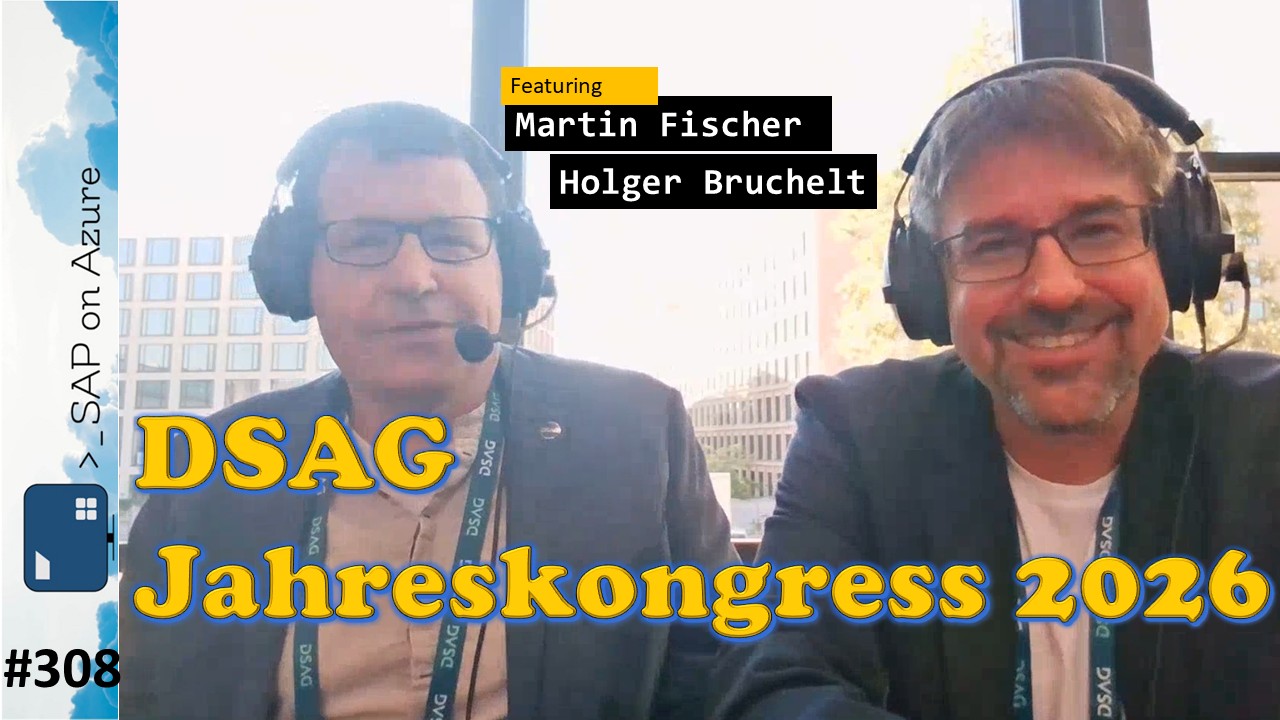
Episode #308
Introduction
In episode 308 of our SAP on Azure video podcast we talk about impressions from the German-speaking SAP User Group Congress 2026 in Cologne.
This time we have a special episode together with Martin Fischer from Neptune Software, recorded live from DSAG. We look back at the first two days of the conference, including the DSAG keynotes, the annual survey results, and the discussions around S/4HANA, ECC, RISE, AI, Joule, API policy, licensing, sovereignty, and customer readiness.
Together we discuss where SAP’s vision is heading, what customers are excited about, and where many open questions remain — from product maturity and commercial models to the very practical reality that many customers are still working on foundational transformation topics.
Find all the links mentioned here: https://www.saponazurepodcast.de/episode308
Reach out to us for any feedback / questions:
- Goran Condric: https://www.linkedin.com/in/gorancondric/
- Holger Bruchelt: https://www.linkedin.com/in/holger-bruchelt/
#Microsoft #SAP #Azure #SAPonAzure #DSAG #S4HANA #RISEwithSAP #BusinessAI #Joule #CleanCore
Summary created by AI
- ECC To S/4HANA Transition:
- Holger and Martin discussed survey results showing that many German-speaking SAP customers remain on ECC or run hybrid landscapes, creating continued demand for migration guidance, foundational modernization, and clear business value for S/4HANA.
- Survey Adoption Results: Holger reported that 54% of survey respondents still use ECC, although some also operate S/4HANA systems. Among S/4HANA users, 56% run the platform on-premises, challenging assumptions that most customers have moved to cloud deployments.
- Migration Business Case: The discussion identified customer questions about the return on investment and practical benefits of moving from ECC to S/4HANA. Customers also need strategies for handling remaining ECC subsystems when only part of their landscape has been migrated.
- Foundational Modernization: Holger and Martin connected the ECC transition with foundational work such as master-data quality, data cleansing, and migration from SAP GUI to Fiori elements. A heavily attended session on a customer’s GUI-to-Fiori journey demonstrated that this remains an active priority for many organizations. Customer And Partner Support: Partners must continue supporting customers with ECC transformations and Fiori adoption while also developing skills in newer AI-related products. The discussion emphasized that modernization can be staged, with Fiori and underlying data services providing a potential foundation for later AI use cases.
- AI Readiness And Autonomous Enterprise:
- Holger and Martin reviewed SAP’s autonomous-enterprise vision and AI roadmap, while contrasting SAP’s forward-looking messaging with survey evidence that many customers and partners still require foundational work before adopting newer capabilities.
- Current AI Adoption: Holger said 43% of survey respondents reported implemented AI use cases, often outside SAP solutions. Examples included connecting Microsoft Copilot to SAP systems, indicating that some customers are proceeding with AI independently while others await SAP capabilities.
- SAP Product Roadmap: The keynote covered the autonomous enterprise, AI, Joule, and Joule Studio. Holger noted that several capabilities were expected to become generally available, while early-adopter care programs were already operating for selected products and further announcements were anticipated around TechEd.
- Readiness Gap: SAP’s keynote presented technology, customers, and partners as ready to proceed, but Holger challenged that conclusion. He linked the readiness gap to the high proportion of ECC customers, incomplete data foundations, ongoing Fiori migrations, and products that were still in early-adopter programs.
- AI Quality Dependencies: The discussion stressed that AI outcomes depend on reliable underlying data and processes. Holger noted that customers without cleansed master data or modernized systems may not be prepared for AI, reinforcing the principle that poor input data produces poor results.
- Partner Enablement: Partners need to balance investment in emerging AI skills with ongoing demand for ECC, S/4HANA, and Fiori services. Holger said partners must understand SAP’s direction while continuing to serve existing customers whose immediate needs may not involve the newest technology.
- SAP Commercial And Contractual Uncertainty:
- Holger and Martin highlighted unresolved concerns about SAP’s API policy, AI pricing, contract references, and changing public documentation, particularly for smaller customers that lack extensive legal and procurement resources.
- API Policy Clarity: The discussion described SAP’s API policy as a source of market uncertainty: the policy spans two pages but is accompanied by an 18-page FAQ, while key questions about permitted and compliant use cases remain unresolved. Customers need clearer ways to validate whether an implementation complies with the policy.
- AI Pricing: Martin and Holger said the commercial model for new AI capabilities was not yet sufficiently clear for customers to calculate business cases. Without predictable cost information, customers cannot confidently assess or commit to SAP’s future-oriented offerings.
- Changing Contract References: The speakers questioned how customers can rely on contract terms that refer to public websites, future API definitions, or evolving AI architecture strategies. Changes to those external references can make it difficult for customers and partners to make decisions based on stable contractual and technical assumptions.
- Small-Customer Impact: Michael’s comments, as summarized by Holger and Martin, indicated that customers may need partners to interpret contractual conflicts and implications. Larger organizations may have dedicated legal and procurement teams, while smaller companies may depend more heavily on partner guidance.
- Product Complexity And Transformation Transparency:
- Holger and Martin said SAP customers need clearer product roadmaps, migration paths, architecture guidance, licensing information, and explanations of how existing components relate to newly named or bundled products.
- Migration Roadmaps: The keynote discussion called for formalized product roadmaps and clear migration paths. Holger said customers face uncertainty and expense when architecture and integration strategies change after early implementations, potentially forcing them to migrate more than once.
- Product Naming: Holger observed that SAP announcements can make it difficult to determine which capabilities are genuinely new, which existing components have been renamed, and which have been bundled into a new product. Greater transparency would help customers understand what they are adopting.
- Licensing Transparency: The speakers identified licensing-model transparency as a recurring customer requirement, particularly where new products and AI capabilities are involved. Clearer commercial and product information is needed to support planning and transformation decisions.
- Root-Cause Resolution: Holger linked the discussion to the keynote message to fix the system rather than the symptom. The point was that SAP should address underlying causes of customer problems instead of adding layers of complexity around existing issues.
- Conference Keynotes And Industry Direction:
- Holger and Martin recapped the German-speaking SAP user conference in Cologne, including its record scale, the first keynote’s themes, the second keynote’s panel discussion, and the contrast between strong interest in SAP’s vision and remaining implementation questions.
- Conference Scale: Holger said the event had more than 6,000 attendees and approximately 600 sessions across SAP’s topic portfolio. The scale was presented as evidence of strong interest in SAP within the German-speaking market.
- First Keynote Themes: The first keynote, led by Jens Wingerhausen, focused on S/4HANA, AI, data, complexity, and transformation. The conference theme was “Claim Your Ground, Own Your Business,” framing the event around customer control and business ownership.
- Second Keynote Panel: The second keynote was a panel involving representatives responsible for areas including service, support, licensing, HR, public service, logistics, and finance. The panel discussed customer readiness, product readiness, strategic direction, and customer pain points, with a more optimistic view than Holger’s assessment.
- Operational And Regulatory Questions: The panel discussion raised questions about operating SAP-managed AI offerings, integrating them into customer environments, communicating changes to operating models, and handling regulatory implications that may vary by country, industry, or domain. Holger said many of these questions remained unanswered.
- Market Interest: Holger and Martin observed strong interest on the exhibition floor, including at SAP’s booth and partner areas such as Neptune’s. They said customers were interested in experiencing the new capabilities, even though practical, commercial, and readiness questions remained.
- 0:00 Intro
- 0:45 Live from DSAG Congress 2026 in Cologne
- 2:10 What to expect from this conference recap
- 3:07 DSAG growth and keynote themes
- 4:20 S/4HANA adoption and ECC reality
- 7:07 RISE, on-premises S/4HANA, and AI access
- 9:00 SAP AI adoption beyond SAP solutions
- 10:02 SAP API policy and market uncertainty
- 12:10 Complexity, roadmaps, and migration paths
- 15:00 Fix the system, not the symptoms
- 16:05 SAP keynote - autonomous enterprise and Joule
- 17:30 Are products, customers, and partners ready?
- 20:00 From SAP GUI to Fiori elements
- 25:05 DSAG panel discussion and customer readiness
- 28:10 Licensing, contracts, and commercial uncertainty
- 30:40 Sovereignty, operations, and AI model transparency
- 32:00 Positive energy on the show floor and wrap-up