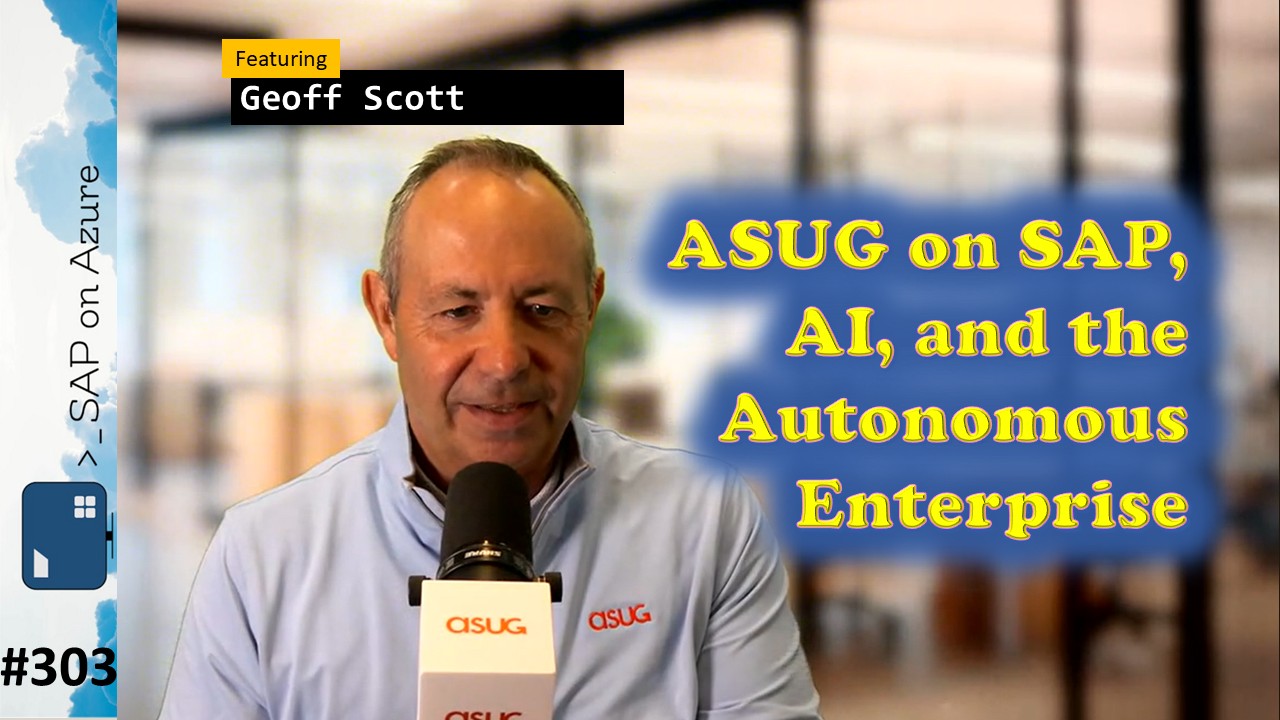
Episode #303
Introduction
In episode 303 of our SAP on Azure video podcast we are very happy to welcome back Geoff Scott, CEO and Chief Community Champion at ASUG. With ASUG Tech Connect coming up this fall, there is a lot happening in the SAP community — especially around AI, agents, governance, and the Autonomous Enterprise.
What I find really interesting is that the discussion has moved beyond high-level AI demos. SAP customers are now asking very practical questions: How do we make this real? How do we govern agents? Is our data ready? What skills do our teams need? And most importantly, where is the business value?
So today we want to hear directly from Geoff what ASUG is seeing across its member community, what questions customers are bringing to ASUG, and how organizations are thinking about the path from AI experimentation to real autonomous business processes.
Find all the links mentioned here: https://www.saponazurepodcast.de/episode303
Reach out to us for any feedback / questions:
- Goran Condric: https://www.linkedin.com/in/gorancondric/
- Holger Bruchelt: https://www.linkedin.com/in/holger-bruchelt/
#Microsoft #SAP #Azure #SAPonAzure #ASUG #AI #AgenticAI #S4HANA #Copilot
Summary created by AI
- S/4HANA As The AI Foundation:
- Geoff Scott explained to Holger and Goran that SAP customers should accelerate their S/4HANA journeys because a structured ERP foundation is increasingly necessary to use AI capabilities from SAP, Microsoft, and other providers.
- ERP Modernization: Geoff said the SAP customer community has pursued HANA and S/4HANA adoption for roughly 12 years, but many organizations remain unfinished or have decided not to proceed. He argued that AI adoption will not wait for these transformations to finish, making S/4HANA readiness more urgent.
- Overlapping Journeys: Geoff described the S/4HANA adoption curve and the AI adoption curve as collapsing into each other rather than occurring sequentially. Organizations therefore need to use emerging AI tools to help complete their S/4HANA transformations instead of postponing AI work until the ERP program is complete.
- Migration Acceleration: Holger shared a Microsoft customer example in which a planned three-year S/4HANA migration was paused and reassessed to determine how AI could assist. The revised approach reduced the migration timeline by approximately 50%, to about 18 months, and the case study was published with SAP.
- Data And Code Remediation: Geoff identified master-data and data-quality remediation as immediate priorities. He noted that many S/4HANA programs have effectively lifted and shifted ECC content without preparing it for AI, and that business-process rules and context may also be hidden in legacy ABAP reports and code, requiring remediation beyond simply validating that the code runs.
- AI Adoption And Community Enablement:
- Geoff outlined ASUG’s North American program for helping SAP professionals move from basic AI understanding to practical adoption through standardized chapter programming, guided experimentation, and the upcoming ASUG Tech Connect agenda.
- Chapter Programming: ASUG plans more than 60 geographic chapter meetings across the United States and Canada between the meeting date and the end of the year, continuing into early spring. Because travel to centralized events is more difficult in North America, the chapter model brings guidance to local SAP professionals.
- AI Fundamentals: The first core chapter theme is helping SAP professionals understand AI fundamentals and create AI-enabled workflows for their daily work. Geoff said the focus is not casual use of public chat tools, but understanding how AI can become part of an SAP professional’s working environment.
- Confidence Building: The second theme is enabling approximately 130,000 known North American SAP professionals to understand what they can do with AI. ASUG wants to reduce uncertainty by providing practical starting points and a safe community context for experimentation; Geoff cited a recent AI webinar that exceeded ASUG’s normal virtual-program benchmarks.
- Consistent Content: ASUG is changing its chapter model from allowing each of its 39 chapters to create independent programming to providing consistent sessions and content across chapters. Geoff said the same two core themes will also appear at ASUG Tech Connect in Fort Worth, alongside additional AI-focused themes.
- AI Governance And Controlled Experimentation:
- Holger raised increasingly specific governance questions about limiting agents’ access to SAP, MCP servers, and email, and Geoff responded that governance is essential but should follow initial experimentation, testing, and clearly prioritized use cases.
- Access Controls: Holger described customer scenarios in which an agent may connect to SAP or one MCP server but must be prevented from connecting to another MCP server or sending email. This illustrates the need for precise authorization boundaries as customers progress from basic AI demonstrations to more mature agent architectures.
- Risk Classification: Geoff said ASUG’s board research classifies AI opportunities using a green-, yellow-, and red-light model. Green-light activities can begin immediately, yellow-light activities should be carefully piloted and explored, and red-light activities require extreme caution or may be inappropriate. The research is planned for distribution to ASUG Executive Exchange members later in the fall.
- Governance Timing: Geoff characterized governance as a major future requirement but a second-order problem when introduced before any experimentation. He recommended first building practical experience through exploration, trials, and testing, then applying appropriate guardrails as use cases and risks become clearer.
- Continuous Testing: Geoff said AI-assisted testing, regression testing, and evaluation should begin immediately and will become critical as software changes accelerate. Instead of relying on end users to discover issues, organizations can define expected end-state data, run tests continuously, and investigate any unexplained deviation—potentially as often as every 15 minutes.
- Practical AI Priorities:
- Geoff identified four near-term priorities for SAP customers and professionals: AI-assisted ABAP and extension development, AI-supported testing, faster S/4HANA transformation, and master-data and data-quality remediation.
- ABAP Assistance: Geoff said AI-assisted ABAP and extension development is available now and should be adopted as an immediate practical use case. Holger supported this with his experience using Copilot and AI assistance to develop more ABAP code in three months than he had written during the previous decade.
- Testing Automation: AI-assisted testing, regression, and evaluation should be treated as a core capability rather than a one-time project activity. Geoff expects continuous testing to underpin future SAP environments that may receive changes or upgrades much more frequently than traditional three-year upgrade cycles.
- Transformation Support: Geoff recommended using AI to accelerate ongoing S/4HANA programs rather than treating AI as a separate initiative. He acknowledged that organizations may hesitate to change a committed budget and timeline during a major transformation, but said AI can reduce the risk of remaining behind while the ERP program continues.
- Data Quality: Geoff emphasized that AI outcomes depend on reliable master data and high-quality business data. He warned that a lift-and-shift migration can preserve legacy data and process problems, and that organizations may need to resolve those issues before expecting dependable AI-enabled business processes.
- Agentic Workflows And Workforce Evolution:
- Geoff and Holger discussed using agents first for repetitive internal SAP work, allowing professionals to build confidence and reclaim capabilities that have been outsourced, while shifting their roles toward business outcomes and higher-level reasoning.
- Internal Pilot Use Cases: Geoff distinguished the immediate prerequisites for AI adoption from later agentic automation of business processes. He recommended starting with high-repetition, low-value workflows performed by SAP professionals, using agents as a practical laboratory to learn their capabilities and limitations.
- Reclaiming Expertise: Geoff said agents may allow SAP organizations to bring work back in-house that has traditionally been outsourced. He observed that organizations retaining internal technical and business-process knowledge can experiment and innovate more quickly because they have direct access to the expertise needed to use AI tools.
- Business Partnership: Geoff envisioned IT professionals being able to ask line-of-business colleagues what outcomes they need and then use agents to implement defined requirements much faster than traditional projects measured in months, years, and large budgets. He said this could shift discussions away from implementation constraints and toward what the business wants to achieve and why.
- Professional Skills: Geoff said SAP professionals are likely to be valued increasingly for judgment, domain knowledge, and intellectual problem-solving rather than only for writing code. Holger described using AI to explore ideas and develop ABAP despite no longer working as an ABAP developer full time, illustrating the broader access to technical experimentation.
- Employment Adaptation: In response to Goran’s question about whether SAP jobs will disappear, Geoff said people who insist on performing only traditional ABAP programming may be at risk, while those who adapt to AI-enabled ways of working can continue contributing. He compared the transition to moving from horse-drawn transport to automobiles: the activity remains, but the tools and scale change.
- Code Volume And Continuous Quality:
- Geoff warned that AI will multiply the amount of enterprise code, making existing weaknesses in code management more consequential and requiring stronger guardrails, security practices, and continuously running quality controls.
- Code Proliferation: Geoff estimated that a large enterprise may already manage around 100 million lines of purchased and internally developed code, and said AI could multiply that volume by three, five, or ten times. He challenged organizations to assess how securely and effectively they manage their current code before expanding it substantially.
- Guardrails: Holger summarized the implication as a need for appropriate guardrails. Geoff agreed that the growth in AI-generated or AI-assisted code makes governance, security, testing, and visibility necessary rather than optional.
- Rapid Change: Geoff contrasted traditional SAP environments that might undergo upgrades every three years with future environments that could change every three weeks. This frequency requires automated and continuous validation instead of periodic manual testing.
- Security Monitoring: Holger noted that security is already being affected by rapid AI development and that agents may need to monitor environments continuously to detect and defend against changing threats. He added that development is only one area; business processes, security, and data also present significant opportunities for agent use.
- 0:00 Intro
- 0:30 Welcome Geoff Scott
- 1:39 Geoff back on the podcast
- 2:46 ASUG perspective from North America
- 3:12 Why S/4HANA matters in the AI era
- 6:04 Customers are asking more concrete AI questions
- 6:31 ASUG fall chapter meetings
- 7:18 Two core themes for the SAP community
- 8:00 AI fundamentals for SAP professionals
- 9:32 S/4HANA and AI journeys are colliding
- 10:54 ASUG Tech Connect and SAP TechEd timing
- 11:31 Bringing consistent programming to ASUG chapters
- 12:20 Copilot Studio and SAP basics
- 12:54 Governance questions around agents and MCP
- 14:32 Why agent governance needs attention
- 14:50 ASUG board perspective on AI
- 15:21 Green, yellow, and red light AI scenarios
- 16:36 AI-assisted ABAP and extension development
- 16:45 AI-assisted testing and regression
- 17:15 Accelerating S/4HANA transformation
- 18:16 Master data and data quality remediation
- 19:46 Business process context hidden in ABAP code
- 20:52 Microsoft’s own S/4HANA transformation perspective
- 22:23 Helping SAP professionals get comfortable with AI
- 23:22 From AI assistance to agentic scenarios
- 24:14 Building confidence with internal AI workflows
- 25:17 Taking back ownership with AI agents
- 27:28 Governance after experimentation
- 28:03 Asking the business - what do you want?
- 30:41 Vibe coding, ABAP, and governance
- 31:23 Managing much more code in an AI world
- 32:09 Continuous testing for fast-changing systems
- 33:28 Security, data, and agents
- 34:17 The future role of SAP professionals
- 36:07 Will SAP jobs disappear?
- 37:52 Wrap-up and upcoming events