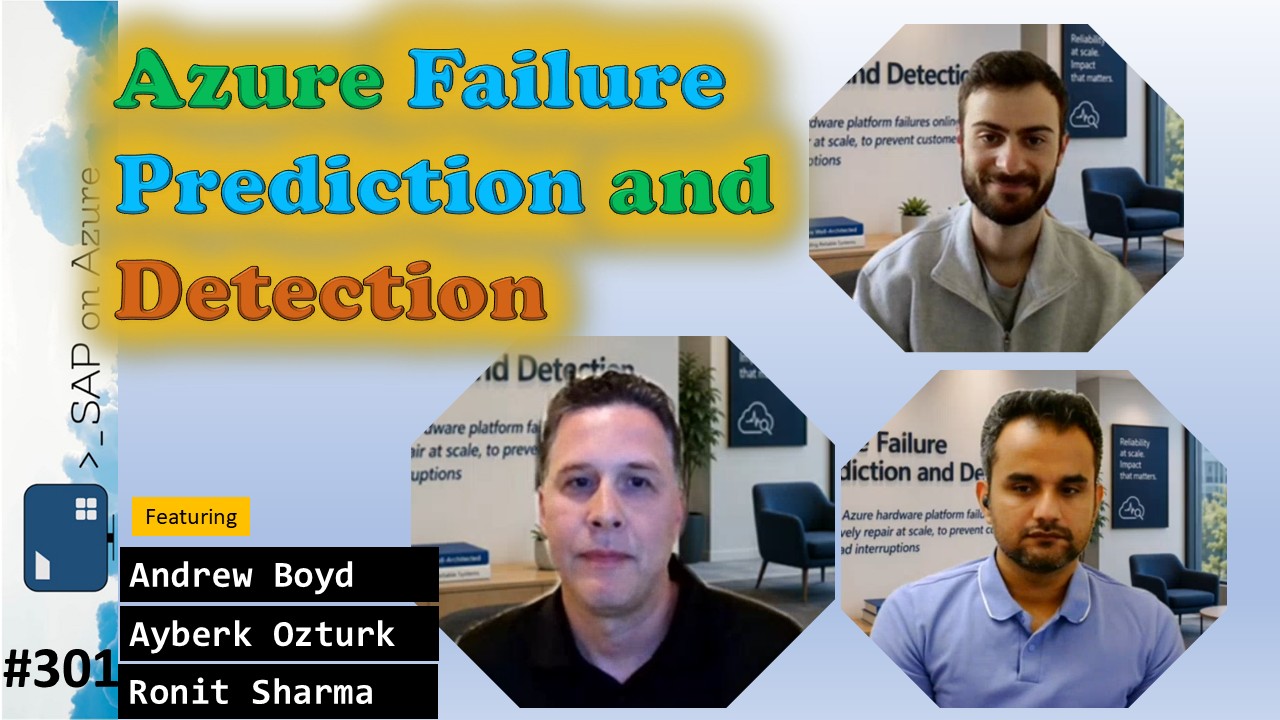
Episode #301
Introduction
In episode 301 of our SAP on Azure video podcast we dive into Azure Failure Prediction and Detection and how Microsoft is proactively protecting mission-critical SAP workloads.
We’re joined by Andrew, Ronit, and Ayberk from Microsoft to discuss how Azure uses machine learning and advanced telemetry to predict hardware issues and minimize downtime—even before customers notice. Whether your SAP systems demand always-on reliability or you’re curious about the latest in cloud infrastructure resilience, this episode is packed with insights you won’t want to miss.
Find all the links mentioned here: https://www.saponazurepodcast.de/episode301
Reach out to us for any feedback / questions:
- Goran Condric: https://www.linkedin.com/in/gorancondric/
- Holger Bruchelt: https://www.linkedin.com/in/holger-bruchelt/
#Microsoft #SAP #Azure #SAPonAzure #AzureInfrastructure #CloudReliability #HighAvailability #LiveMigration #EnterpriseCloud #AzureMonitor
Summary created by AI
- Azure Failure Prediction and Detection (AFPD) Overview:
- Ayberk, Andrew, and Ronit introduced the Azure Failure Prediction and Detection (AFPD) system, explaining its evolution from reactive to proactive fault management in Azure infrastructure, with a focus on minimizing customer impact through automation, telemetry, and machine learning.
- Reactive to Proactive Shift: Ayberk described the historical challenges of reactive fault management, including mission-critical customer escalations, supply chain shortages, and manual recovery processes, and explained how AFPD now enables automated failure isolation and self-healing workflows to address these issues before customers are impacted.
- AFPD Mission and Functionality: Ayberk outlined AFPD’s mission to predict hardware platform failures and proactively repair at scale, highlighting that the system constantly monitors the Azure fleet, forecasts failures, and triggers preemptive fixes to prevent customer workload interruptions.
- Impact on Customer Experience: The team emphasized that, prior to AFPD, hardware failures typically led to customer interruptions and required hardware replacement, whereas AFPD now enables live monitoring, early detection, and seamless workload migration with zero interruptions, significantly improving reliability for mission-critical systems like SAP.
- Key Components of AFPD: Andrew explained that AFPD consists of prediction and detection services, mitigation services, and remediation services, all working together to predict or detect failures, select optimal mitigation actions, and quickly repair affected nodes without customer disruption.
- Technical Workflow of Failure Prediction and Mitigation:
- Andrew and Ayberk detailed the technical workflow of AFPD, describing how machine learning models and detection rules identify potential hardware failures, trigger mitigation actions such as live migration, and ensure transparency with customer notifications.
- Prediction and Detection Services: Andrew described how AFPD uses machine learning models and prediction rules to identify failures before they occur, and detection rules to catch issues in near real time, minimizing customer impact.
- Mitigation Actions: Upon predicting a failure, the mitigation service ensures no new customers are placed on the affected node and initiates live migration for existing customers, moving workloads to healthy nodes with no reboot required.
- Remediation Process: After workloads are migrated, the affected node is taken out of production for quick repair using spare management systems, then returned to the fleet, maintaining overall fleet health and capacity.
- Transparency and Customer Notification: The team stressed that transparency is a key pillar, with customers being notified as soon as a failure is detected and mitigation begins, allowing them to take informed actions to avoid workload impact.
- Customer Notification and Interaction with AFPD:
- Ronit demonstrated how customers are notified of AFPD events and can interact with the system through three main Azure endpoints—Resource Health, Resource Graph Explorer, and Event Grid—providing flexibility for both individual VM monitoring and large-scale automation.
- Resource Health Portal: Ronit showed that customers can view detailed health events and AFPD notifications for individual VMs in the Resource Health portal, including information about live migration eligibility, recommended actions, and redeployment deadlines.
- Resource Graph Explorer: For customers managing large fleets, Ronit explained how Resource Graph Explorer enables querying the health status of all VMs at scale, with sample queries and metadata available for automation and dashboard creation.
- Event Grid Integration: Ronit described how Event Grid allows customers to set up listeners for AFPD events, enabling integration with Azure Functions, webhooks, or REST APIs for custom automation and alerting within their own monitoring systems.
- Consistency Across Endpoints: Ronit emphasized that the notification messages are consistent across all endpoints, ensuring customers receive the same information whether they use Resource Health, Resource Graph, or Event Grid.
- Live Migration Versus Service Healing:
- Andrew and Ronit clarified the distinction between live migration and service healing, noting that live migration allows for seamless workload movement without reboot, while service healing previously required VM reboots, and discussed the public availability of live migration.
- Impact on Customer Workloads: Live migration is preferred as it avoids rebooting customer VMs, minimizing disruption, whereas service healing, used before AFPD, involved reboots and greater customer impact.
- SAP-Specific Considerations and Customer Awareness:
- Goran highlighted the importance of AFPD for SAP workloads, noting that many SAP customers are unaware of these features and that proactive notification and flexible integration options are critical for minimizing downtime and business impact.
- SAP System Sensitivity: Goran explained that SAP systems are highly sensitive to downtime, making AFPD’s proactive approach and transparent notifications especially valuable for these customers.
- Customer Education: The discussion revealed that some customers are not aware of the available notification and integration features, underscoring the need for better communication and education to maximize the benefits of AFPD.
- 0:00 Intro
- 0:31 Why SAP workloads need proactive platform reliability
- 1:30 Azure Failure Prediction and Detection overview
- 1:46 Meet Andrew, Ayberk, and Ronit
- 3:29 What AFPD does for customers
- 4:37 From reactive recovery to proactive isolation
- 6:10 Before and after AFPD
- 7:36 Live migration and SAP workload continuity
- 9:55 AFPD ecosystem and components
- 11:48 Mitigation, live migration, and repair flow
- 13:19 Where customers can use AFPD notifications
- 14:31 Customer notifications and Resource Health annotations
- 18:11 Demo - consuming AFPD notifications in Azure
- 18:44 Resource Health for VM-level investigation
- 21:48 Azure Resource Graph for fleet-wide visibility
- 24:27 Event Grid and automation integrations
- 26:22 Choosing the right notification surface
- 28:07 Why this matters for SAP systems on Azure
- 29:24 Further reading and closing
- 30:02 Wrap-up