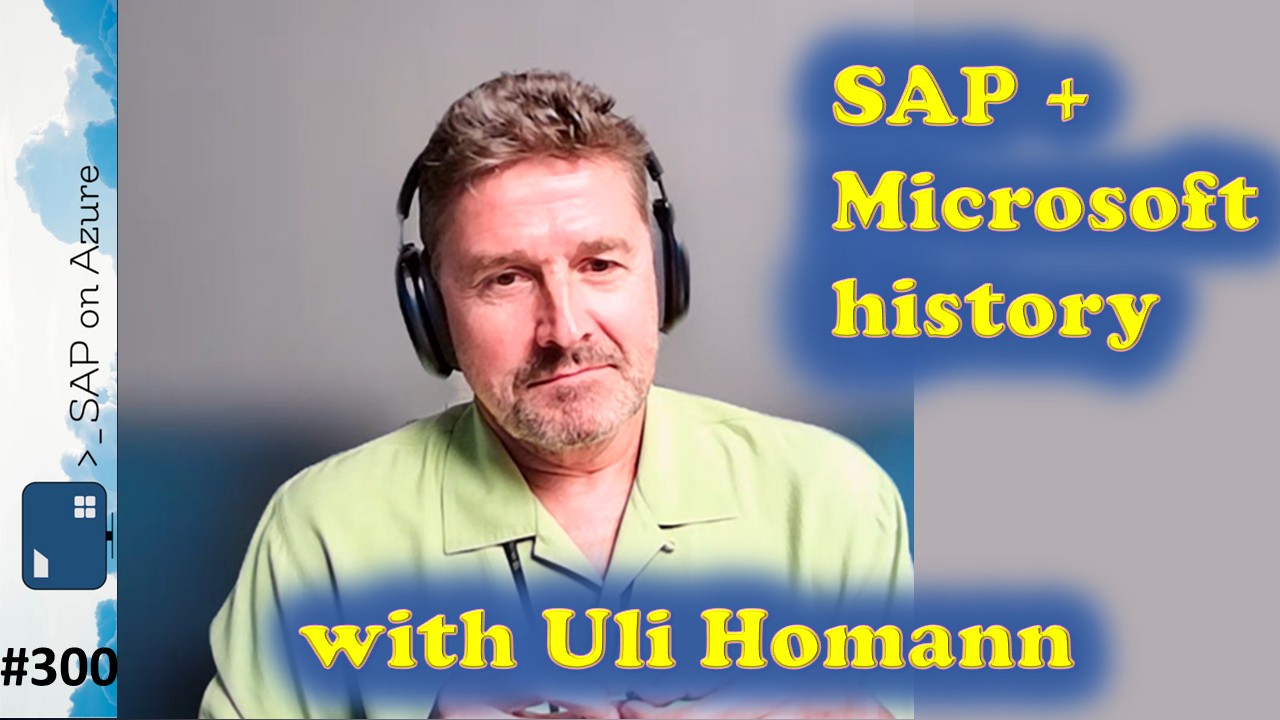
Episode #300
Introduction
Episode 300! For this very special episode of the SAP on Azure Video Podcast, we wanted a very special guest — and we are extremely honored to welcome Uli Homann.
Uli is Corporate Vice President and Distinguished Architect in Microsoft’s Cloud + AI organization, a member of Microsoft’s senior engineering leadership team, and someone who has spent more than 35 years helping customers navigate major technology shifts.
What makes this especially exciting for us is that Uli’s connection to SAP goes back to the early days of his career in Redmond, where he worked directly with SAP and other leading enterprise software vendors to help shape Microsoft’s enterprise platform strategy.
Many of you may also know Uli from Microsoft’s Armchair Architects series, where he discusses the intersection of business strategy, architecture, cloud, and AI.
Find all the links mentioned here: https://www.saponazurepodcast.de/episode300
Reach out to us for any feedback / questions:
- Goran Condric: https://www.linkedin.com/in/gorancondric/
- Holger Bruchelt: https://www.linkedin.com/in/holger-bruchelt/
#Microsoft #SAP #Azure #SAPonAzure #Microsoft #CloudAI #EnterpriseAI #AgenticAI #OpenStandards #A2A #MicrosoftCloud
Summary created by AI
- Historical Collaboration Between Microsoft and SAP:
- Uli Homann shared with Holger Bruchelt and Goran Condric the history of Microsoft and SAP’s partnership, highlighting key milestones such as porting SAP R3 to Windows NT, transitioning from Oracle to SQL Server, and developing foundational integration tools like the DCOM connector and Active Directory integration.
- Porting SAP R3 to Windows NT: Uli described the initial focus of the Microsoft-SAP collaboration, which involved porting SAP R3 from Unix to Windows NT, leveraging his expertise in SQL Server and German language skills to facilitate the process.
- Transition from Oracle to SQL Server: Uli explained the technical challenges of moving SAP R3 from Oracle to SQL Server, particularly the shift from page locking to row-level locking, and credited the SQL Server and SAP database teams for successfully overcoming these complexities.
- Development of DCOM Connector: Uli recounted the creation of the DCOM connector, which enabled Visual Basic developers to interact with SAP solutions, and its evolution into the .NET connector, broadening development integration between the platforms.
- Active Directory and Kerberos Integration: Uli highlighted the integration of Active Directory and Kerberos into SAP R3, which began with Windows NT 5.0 (later Windows 2000), and the earlier development of clustering capabilities with NT4, establishing foundational identity and reliability features.
- Long-Term Impact of Early Integrations: Uli emphasized that the foundational work in database, clustering, identity, and development integration during the first four years of collaboration still underpins current SAP and Microsoft solutions, demonstrating the longevity and continued relevance of these efforts.
- Mutual Customer Relationship and Its Influence:
- Holger and Uli discussed the significance of Microsoft and SAP being customers of each other, detailing how this reciprocal relationship drives product quality, integration standards, and confidence among enterprise customers.
- Microsoft’s Adoption of SAP for Finance: Uli narrated how Microsoft adopted SAP to streamline its finance function, moving from complex legacy systems to SAP R3 on Oracle and later SQL Server, which improved internal processes and created market opportunities for both companies.
- Demanding Customer Dynamics: Uli explained that both Microsoft and SAP are demanding customers of each other, which ensures high standards and continuous improvement in their respective products and services.
- Integration Points and Open Standards: Uli described how the mutual customer relationship highlights integration points, such as the copilot 365 strategy and agent-to-agent protocol, and drives the adoption of open standards for broader industry impact.
- Confidence for Enterprise Customers: Holger noted that the fact both companies run each other’s solutions provides reassurance to other customers, encouraging them to trust Microsoft and SAP as their vendors.
- Commitment to Open Standards and Industry Collaboration:
- Uli, Holger, and Goran discussed the tradition of Microsoft and SAP collaborating on open standards, such as OData, Kerberos, and agent-to-agent protocols, ensuring industry-wide adoption and interoperability.
- OData Protocol Development: Holger recalled how SAP and Microsoft jointly drove the OData specification, making it an open protocol used across the industry rather than a proprietary solution.
- Kerberos for Identity Integration: Uli explained the decision to use Kerberos as the security standard for identity integration, rather than developing a proprietary solution for Active Directory, reinforcing the commitment to open standards.
- Establishing Standards in Enterprise: Uli emphasized that SAP and Microsoft have the influence to establish open standards in the enterprise space, leveraging their combined weight to promote interoperability.
- Agent-to-Agent Protocol and Open Telemetry: Uli mentioned ongoing collaboration on agent-to-agent protocols and open telemetry for observability, as well as joint efforts on identity standards, with both companies committed to advancing these open technologies.
- Future Outlook: AI, Agents, and Autonomous Enterprise:
- Uli provided insights to Holger and Goran on the evolving landscape of enterprise software, focusing on the shift towards AI, agent-based execution, and the autonomous enterprise, and how Microsoft and SAP are preparing for these changes.
- Role of SaaS Solutions: Uli asserted that enterprises will continue to rely on SaaS solutions from vendors like Microsoft and SAP due to the complexity of maintaining, updating, and securing global business processes.
- Agent-Based Execution Environments: Uli discussed the transition to agent-based execution, where agents handle deterministic workflows and processes, reducing the need for traditional user interfaces and shifting some tasks directly to users as needed.
- Expressing Business Process as Agent Know-How: Uli described the emerging trend of encoding business process value as agent know-how rather than code or workflow, citing examples from startups using AI to interpret and act on regulatory changes.
- Collaboration on AI and Integration Standards: Uli highlighted Microsoft and SAP’s commitment to open standards in AI integration, including agent-to-agent protocols, open telemetry, and identity standards, and anticipated continued joint efforts in these areas.
- 0:00 Intro
- 0:30 Meet Uli Homann
- 2:24 Looking back at SAP and Microsoft milestones
- 2:34 SAP R/3 on Windows NT and SQL Server
- 4:15 Project Sphinx and row-level locking
- 5:15 DCOM, Active Directory, Kerberos, and clustering
- 9:31 How SAP shaped Microsoft product development
- 10:05 Microsoft as an SAP customer
- 15:06 Customer value across the SAP and Microsoft ecosystem
- 15:41 A2A, OData, Kerberos, and open standards
- 20:34 Regulation, compliance, and enterprise AI
- 21:14 Agents as the future execution environment
- 24:15 Microsoft’s commitment to open standards
- 25:30 Wrap-up