Episode #299
Introduction
In episode 299 of our SAP on Azure video podcast we talk about Business Process Solutions.
We have spoken a lot about integrating SAP data with Microsoft Fabric. There is the technical part of the integration, but there is also the semantic aspect. With Business Process Solutions, we provide a set of prebiuld resources, like data models, transformations and business templates that customers can use to quickly get started. We already talked about this some time back, so today I am happy to welcome my colleauge Bartosz back with us on the show to give us an update.
Find all the links mentioned here: https://www.saponazurepodcast.de/episode299
Reach out to us for any feedback / questions:
- Goran Condric: https://www.linkedin.com/in/gorancondric/
- Holger Bruchelt: https://www.linkedin.com/in/holger-bruchelt/
#Microsoft #SAP #Azure #SAPonAzure #MSFabric #Data #BusinessProcessSolution #ETL #PowerBI
Summary created by AI
- Overview and Purpose of Business Process Solutions (BPS):
- Holger and Bartosz discussed the motivation behind Business Process Solutions (BPS), emphasizing its role in simplifying SAP data integration with Microsoft Fabric and providing customers with pre-built resources, templates, and best practices to accelerate deployment and reporting.
- Customer Integration Challenges: Bartosz explained that customers face complex IT landscapes with multiple ERP systems and specialized applications, making end-to-end insights difficult. BPS addresses these challenges by offering a unified solution for integrating SAP and other business applications.
- Pre-Built Templates and Accelerators: Holger and Bartosz described how BPS provides pre-built data models, transformation logic, and Power BI dashboards, enabling customers to quickly deploy solutions and customize them as needed, rather than building from scratch.
- Open Source and Customization: Bartosz highlighted that all transformation logic and notebooks in BPS are open source, allowing customers to modify, extend, and adapt the solution to their specific requirements, including adding custom tables and objects.
- Supported Business Processes: Bartosz outlined the business processes currently supported by BPS, including finance, sales, procurement, and manufacturing, each with dedicated data models and templates for rapid reporting and analytics.
- Technical Architecture and Deployment of BPS in Microsoft Fabric:
- Bartosz provided a detailed walkthrough of how BPS is deployed as a workload in Microsoft Fabric, including configuration steps, supported source systems, and integration options, with Holger confirming the ease of use and flexibility for customers.
- Workload Activation and Configuration: Bartosz explained that BPS can be activated in Microsoft Fabric by selecting the enhancement for specific workspaces or capacities, after which customers can configure source systems and deploy solutions.
- Source System Setup: Bartosz demonstrated the process of configuring a new source system, including specifying the SAP system type and version, and choosing the connection method such as Azure Data Factory, open mirroring, or SAP Data Sphere.
- Automated Data Model Discovery: Bartosz showed that when deploying a Power BI report, BPS automatically discovers and activates the required data model, streamlining the process and allowing reuse of existing models across dashboards.
- Business Process Solutions Reporting and Analytics Capabilities:
- Bartosz and Holger reviewed the range of Power BI dashboards and reports available in BPS, covering key business processes such as finance, sales, procurement, and manufacturing, and discussed their features, customization options, and partner ecosystem.
- Finance Insights and GL Analytics: Bartosz described dashboards for GL account balances, financial statements, and profitability, which provide hierarchical views and master data translations for rapid financial analysis.
- Spend Analysis and Supplier Evaluation: Bartosz explained the spend insights dashboard, which offers views on supplier networks, pricing, and opportunities for consolidation, with features like currency conversion and category analysis.
- Sales and Opportunities Overview: Bartosz highlighted dashboards for sales revenue, pipeline health, and opportunities, including integration with Salesforce and the ability to compare data across systems.
- Accounts Payable and Receivable Reporting: Bartosz discussed aging reports and customer/supplier balances, which enable monitoring of overdue payments and transaction volumes.
- Partner Content and Ecosystem: Bartosz noted that partners such as Celebal Technologies build additional dashboards on top of BPS, leveraging standardized data models for enhanced reporting.
- Recent Enhancements and New Features in BPS:
- Bartosz presented the latest updates to BPS, including expanded data extraction options, new data models for manufacturing and procurement, improved semantic models for sales, and enhanced AI and forecasting capabilities.
- Data Extraction Options: Bartosz described three pillars for data ingestion: Microsoft first-party solutions, partner connectors (DAB, Asapio, Theobald, Simplement), and SAP Data Sphere, with new ABAP Copy Job integration in private preview.
- Manufacturing and Procurement Data Models: Bartosz announced new star schemas for manufacturing (orders, operations, components, confirmations) and extended procurement coverage for ECC customers, enabling more comprehensive analytics.
- Improved Semantic Models for Sales: Bartosz explained enhancements to the sales semantic model, including simplified star schema design and configurable parameters for deterministic AI responses.
- AI and Data Agent Integration: Bartosz discussed the integration of Copilot and Data Agent with BPS, enabling customers to query their SAP data using natural language and receive reliable, deterministic answers.
- AI-Driven Analytics and Financial Forecasting in BPS:
- Bartosz demonstrated the use of AI and Data Agent for querying SAP data, customizing semantic models for deterministic answers, and provided an overview of the financial forecasting features, including model evaluation and out-of-the-box notebooks for customers.
- Semantic Model Customization for AI: Bartosz showed how customers can configure base filters and parameters in the sales semantic model to improve the determinism of AI responses, ensuring consistent answers to business questions.
- Data Agent Query Examples: Bartosz demonstrated querying incoming order values and new customer counts in different currencies, with Data Agent applying real-time currency conversion and leveraging pre-built measures.
- Financial Forecasting Process: Bartosz explained the guided forecasting process in BPS, which includes evaluating data quality, recency, and noise, and training models on financial metrics such as revenue and gross profit.
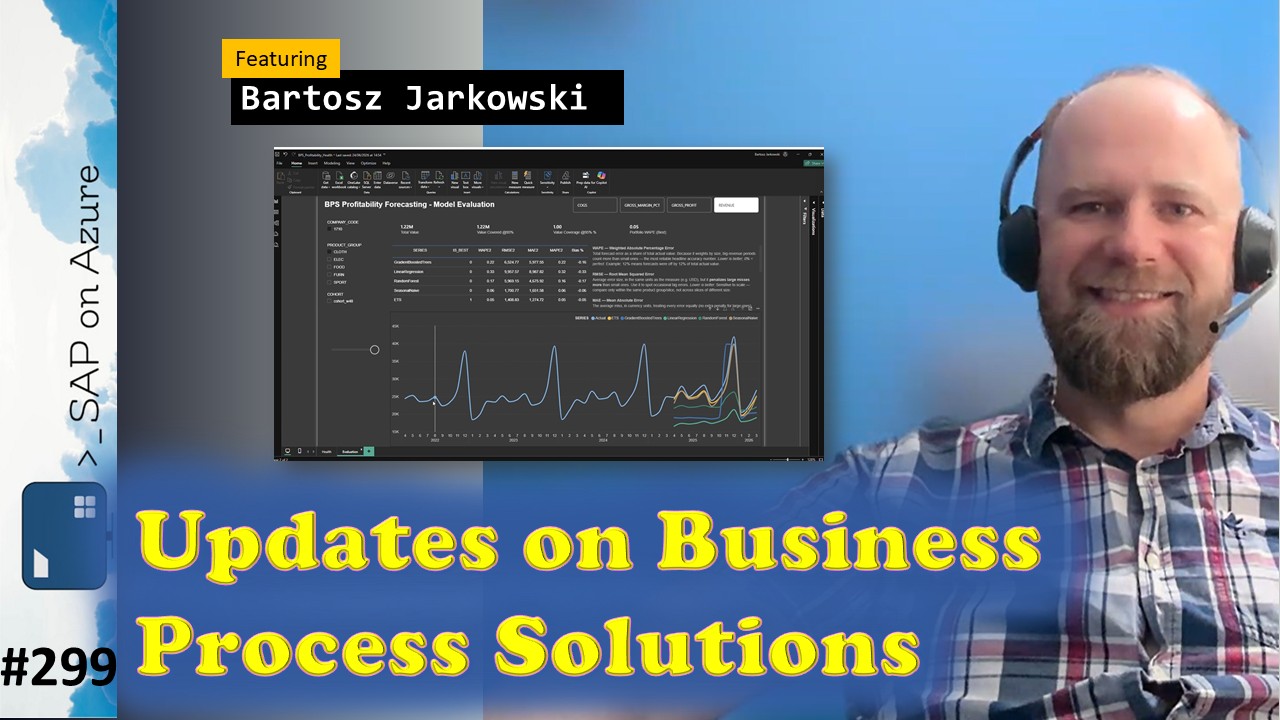
- Model Evaluation and Selection: Bartosz presented the evaluation of forecasting models (ETS, Seasonal Naive, Linear Regression, Random Forest, Gradient Boosted Trees), showing how customers can select the best model based on accuracy metrics like WAPE and RMSE.
- Customer Feedback and Continuous Improvement:
- Bartosz emphasized the importance of customer feedback in driving BPS development, inviting users to provide input via LinkedIn or the built-in feedback button, and highlighted the team’s commitment to evolving BPS based on customer needs.
- Feedback Mechanisms: Bartosz explained that customers can submit feedback directly within BPS or contact him via LinkedIn, and that the team is highly responsive to customer-driven feature requests.
- Update and Support Process: Bartosz noted that BPS artifacts are regularly updated with new features and bug fixes, and customers are encouraged to keep their items up to date for the latest improvements.
- 0:00 Intro
- 0:52 Introducing Bartosz Jarkowski
- 2:48 Bartosz’s role and focus area
- 3:58 Why Business Process Solutions was created
- 6:19 Complex enterprise application landscapes
- 8:28 Enterprise data fabric for end-to-end insights
- 9:21 SAP data integration complexity
- 12:00 What BPS provides out of the box
- 16:15 BPS analytical scope and data models
- 17:44 BPS as a Microsoft Fabric workload
- 20:14 Demo - Configure an SAP source system
- 22:02 Demo - Deploy insights with the wizard
- 24:00 Available Power BI dashboards
- 27:30 What’s new in Business Process Solutions
- 28:04 Data ingestion options and partner solutions
- 30:17 SAP Datasphere and ABAP Copy Job
- 31:00 New data models for manufacturing and ECC procurement
- 32:52 AI, Copilot, and Data Agents with SAP data
- 33:20 Making Data Agents more deterministic
- 34:15 Demo - Simplified semantic model
- 37:19 Demo - Sales Data Agent and reusable measures
- 40:48 Financial forecasting with BPS
- 42:37 Forecasting notebooks and evaluation dashboard
- 44:47 Forecast model evaluation
- 46:47 Roadmap - Stock insights and manufacturing data
- 48:20 Feedback and preview registration
- 50:01 Wrap-up and next steps