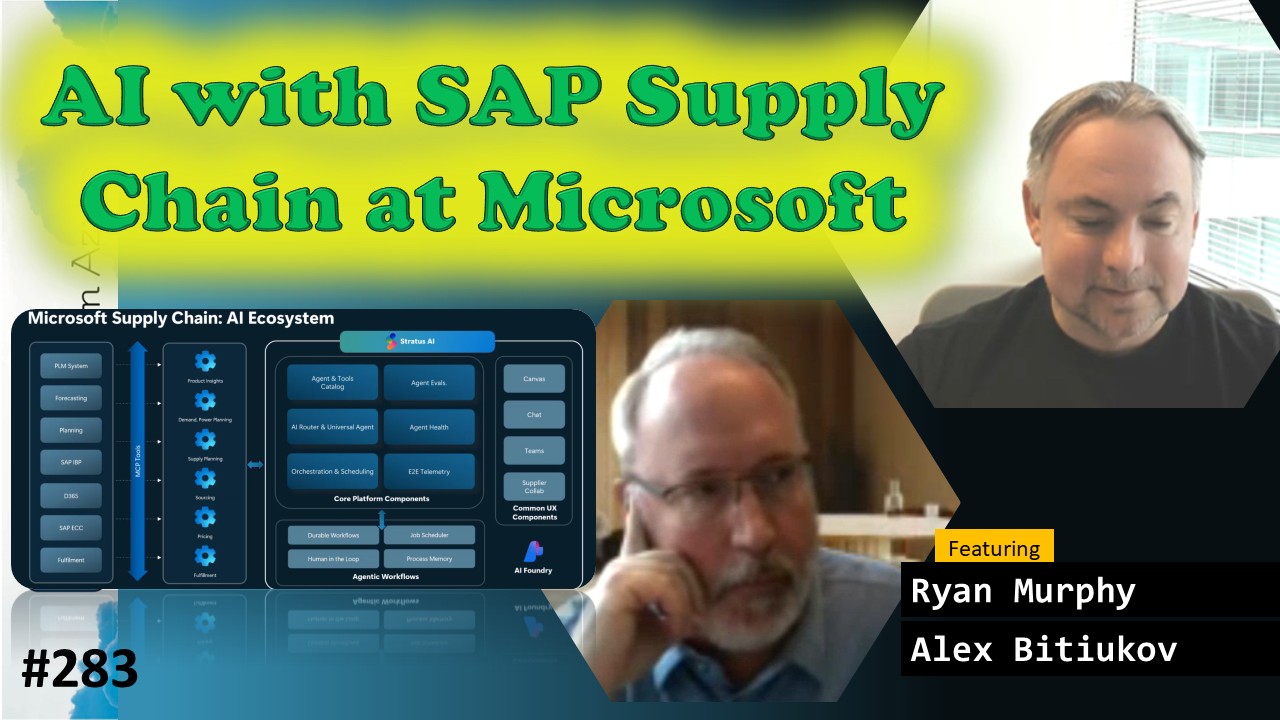
Episode #283
Introduction
In episode 283 of our SAP on Azure video podcast we talk about AI with SAP Supply Chain at Microsoft for ECC.
We have talked in the past about the Joule and Copilot integration and what overwhelming interest we are hearing from customers. Our regular viewers might have wondered what we are doing with the Joule integration at Microsoft and you might remember, that – while we have lots of SaaS and also S/4HANA systems running RISE on Azure at Microsoft – we also have a really important ECC System. We are already working on moving it to S/4HANA, but this will take some time. So our Supply Chain Team explored what they can do to still enable a Copilot interaction with the SAP System and invented Stratus AI. To tell us more about this, I am glad to have Alex Bitiukov and Ryan Murphy with us here today.
Find all the links mentioned here: https://www.saponazurepodcast.de/episode283
Reach out to us for any feedback / questions:
- Goran Condric: https://www.linkedin.com/in/gorancondric/
- Holger Bruchelt: https://www.linkedin.com/in/holger-bruchelt/
#Microsoft #SAP #Azure #SAPonAzure #Copilot #MCP #SCM #StratusAI
Summary created by AI
- Microsoft Supply Chain AI Transformation:
- Ryan Murphy and Alex Bitiukov detailed Microsoft’s journey in transforming its supply chain operations using advanced AI, including the development and deployment of Stratus AI, to address the challenges of scale, complexity, and integration with SAP and other systems.
- Supply Chain Overview: Ryan Murphy explained that Microsoft’s supply chain team is responsible for designing, manufacturing, and delivering hardware for data centers globally, managing billions of dollars in assets, and ensuring capacity to meet rapidly growing customer demands.
- Hybrid System Architecture: Ryan described the hybrid architecture combining first-party Microsoft applications and SAP tools, with SAP ECC as the transactional core, IBP for planning, and integration with various partners and suppliers, all supported by a centralized data platform being tuned for AI.
- AI-Driven Transformation: Alex Bitiukov recounted how the team began experimenting with generative AI after COVID, initially focusing on explicability use cases to help humans process complex data, and gradually expanding to automation of repetitive tasks, leading to significant productivity gains.
- Sustainability and Circular Supply Chain: Ryan highlighted Microsoft’s commitment to sustainability, including zero waste goals, and described how AI and supply chain applications support the reuse, resale, or recycling of decommissioned hardware, scaling with the growth in decommissioning volumes.
- Stratus AI Platform Development and Governance:
- Alex Bitiukov and Ryan Murphy discussed the evolution of Stratus AI as a central agent orchestration and governance platform, emphasizing reusable components, common user experience, and robust governance to manage and scale AI agents across the supply chain.
- Agent Development and Use Cases: Alex explained that over three years, the team developed around 60 production agents for various supply chain tasks, ranging from data explanation to exception handling, with some agents saving thousands of hours monthly and all running on the Stratus AI platform.
- Governance and Standardization: Alex described how Stratus AI enforces governance by requiring agents to be registered, undergo evaluation, and meet responsible AI, accessibility, and data quality standards before deployment, ensuring consistency and reliability across the organization.
- Reusable Components and Common UX: Both Alex and Ryan emphasized the importance of building reusable components and a unified user interface, which allows engineering teams to focus on solving business problems rather than rebuilding technical stacks, and ensures a consistent experience for users.
- Lessons Learned and Platform Maturity: Ryan noted that early experimentation led to silos and duplicate tools, but the adoption of Stratus AI as a shared platform enabled consolidation, efficiency, and the migration of capabilities to more mature AI Foundry components where appropriate.
- Integration of Stratus AI with SAP and Future-Readiness:
- Alex Bitiukov and Ryan Murphy outlined how Stratus AI integrates with SAP ECC and other third-party systems using MCP and A2A protocols, enabling seamless agent-driven transactions and positioning the architecture for future SAP evolutions such as S/4HANA and Joule.
- Technical Integration Approach: Alex explained that Stratus AI acts as the orchestration layer, connecting to SAP ECC via MCP, allowing users to perform SAP transactions without leaving the Stratus AI interface, and piloting A2A protocol integration with SAP Joule for future use cases.
- Abstraction and User Experience: Alex highlighted that the architecture abstracts backend system changes from end users, so planners do not need to learn new interfaces or procedures when underlying systems (e.g., moving from ECC to S/4HANA) are upgraded.
- Future-Proofing and Extensibility: Holger Bruchelt and Alex discussed how the modular, ‘Lego block’ architecture allows for easy integration of new protocols and systems, ensuring that as SAP and other technologies evolve, Stratus AI can adapt without disrupting business processes.
- Security and Access Control: Ryan described ongoing work to ensure authentication, user identification, and transaction authorization are managed by Stratus AI, maintaining privacy and security across legacy and new supply chain tools.
- Agent Workflow Design and Quality Assurance:
- Alex Bitiukov addressed the challenges of agent automation, describing the decomposition of agent workflows, deterministic execution, and quality controls to ensure reliability, accuracy, and compliance with responsible AI standards.
- Workflow Decomposition: Alex explained that agents are designed as workflows with defined steps, such as data retrieval, quality checks, solver execution, result evaluation, and human sign-off, rather than attempting full automation in a single agent.
- Quality Metrics and Human Oversight: Agents are required to report quality and accuracy metrics, escalate exceptions for human approval, and provide explanations for their decisions, ensuring that automation does not compromise reliability or accountability.
- Responsible AI and Evaluation: Before deployment, agents must pass internal responsible AI standards, accessibility, and data quality guidelines, and undergo evaluation to confirm they perform as intended and are accepted by users as production systems.
- Scalability and Organizational Impact of Agentic Automation:
- The team discussed the organizational transformation enabled by agentic automation, including consolidation of institutional knowledge, workflow orchestration, and the potential to scale to hundreds of agents, driving significant ROI and operational efficiency.
- Workflow Orchestration and Knowledge Consolidation: Alex described the vision of consolidating agentic applications into orchestrated, deterministic workflows, centralizing supply chain knowledge, policies, and procedures within Stratus AI to reduce fragmentation and improve process management.
- Scalability and ROI: Holger and Alex noted that the deployment of over 60 agents in production has already demonstrated measurable ROI, and the architecture is designed to support scaling to hundreds of agents as business needs evolve.
- 0:00 Intro
- 1:30 Introducing Ryan Murphy and Alex Bitiukov
- 4:40 Microsoft Cloud Supply Chain
- 7:40 CSCP Architecture -
- 10:30 Scale of our Transformation
- 13:15 Why we needed generative AI
- 21:50 AI Agents (E2E)
- 23:15 AI Foundry and StratusAI Scope
- 30:25 Microsoft Supply Chain - AI Ecosystem
- 36:35 MCP ECC Demo
- 37:50 StratusAI Control Plane