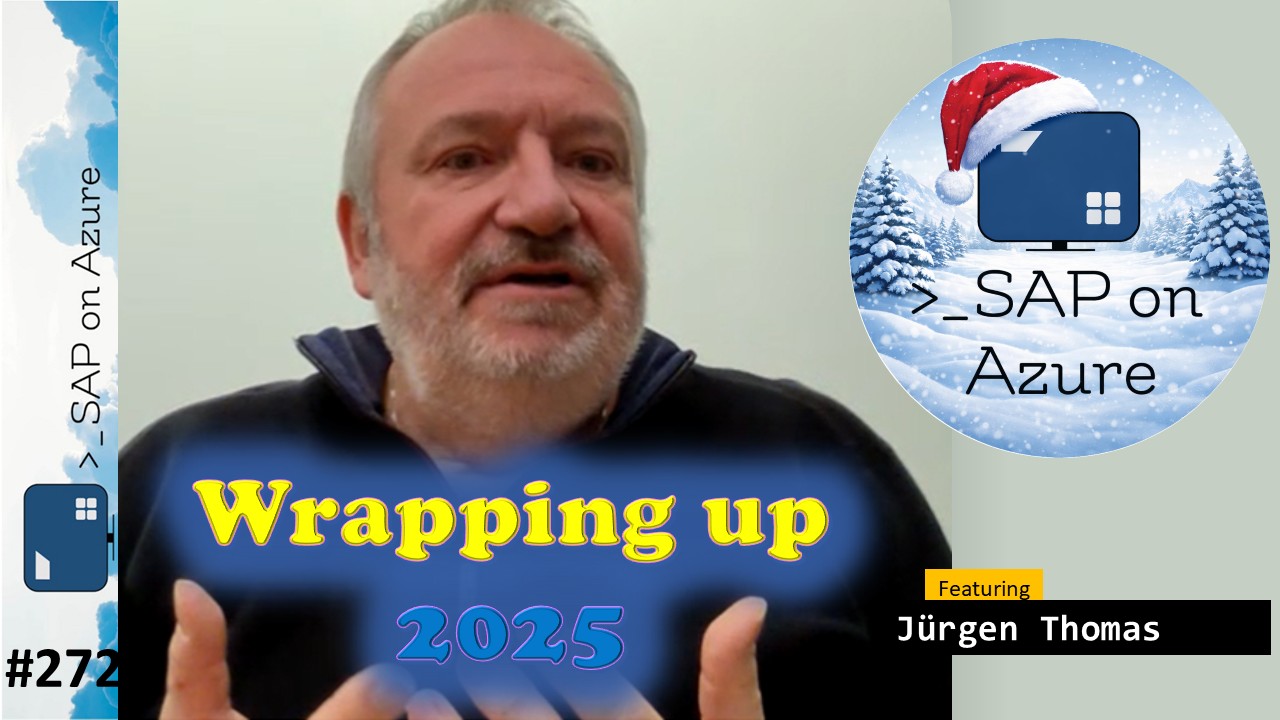
Episode #272
Introduction
In episode 272 of our SAP on Azure video podcast we look back at 2025.
This will be our last episode of the 2025, and like in all the years since 2020, we want to wrap up the year with our colleague Jürgen Thomas.
Find all the links mentioned here: https://www.saponazurepodcast.de/episode272
Reach out to us for any feedback / questions:
- Goran Condric: https://www.linkedin.com/in/gorancondric/
- Holger Bruchelt: https://www.linkedin.com/in/holger-bruchelt/
#Microsoft #SAP #Azure #SAPonAzure #WrapUp2025
Summary created by AI
- SAP Sizing Framework Evolution and Benchmark Automation:
- Juergen Thomas discussed the transition from the traditional SAP SD benchmark to the new Q2C benchmark and ASAPs unit, highlighting the team’s automation efforts and the use of AI for tuning and testing SAP-certified VM types.
- Transition to Q2C Benchmark: Juergen Thomas explained that SAP replaced the long-standing SD benchmark with the new Q2C benchmark, which now uses the ABAP stack of S/4HANA and HANA in a single VM, producing the ASAPs unit for sizing. This change was necessary as the previous benchmark was outdated and no longer maintained.
- Automation and AI in Benchmarking: Juergen Thomas described how the team automated the benchmarking process using AI agent networks, which allowed for efficient tuning and evaluation of VM types. The automation not only improved throughput but also enabled the reuse of the framework for testing other VM characteristics such as storage and network throughput.
- Impact on VM Certification: The team re-evaluated many existing SAP-certified VM SKUs using the new benchmark, discovering differences in performance metrics. The results are being used to update certifications and ensure that VM offerings align with the new ASAPs-based sizing framework.
- Expansion to Other Workloads: The automation and testing framework developed for SAP workloads is being extended to other scenarios, such as Epic Healthcare workloads, which have different performance requirements, particularly in storage throughput and latency.
- Performance Testing, Edge Cases, and Safe Deployment:
- Juergen Thomas outlined the team’s rigorous approach to performance and stability testing for SAP workloads on Azure, including automated 24/7 systems, AI-driven log analysis, and collaboration with development teams to address edge cases and customer scenarios.
- Automated Testing and Safe Deployment: The team maintains automated, continuous testing environments running SAP workloads to catch issues before deployment. These systems are part of a safe deployment process designed to identify and address gaps, especially in edge cases.
- AI-Driven Log Analysis: AI is used to analyze logs from test systems, helping to filter out false positives and ensure that only genuine issues are escalated to development teams. This approach improves the efficiency and accuracy of issue resolution.
- Collaboration with Development Teams: When issues are identified, the team works closely with function teams and acts as a bridge between backing services and development, integrating new scenarios into the testing process and expanding coverage.
- Proactive Expansion of Test Scenarios: The team is not only reactive but also proactively expands test coverage to include more edge cases and main scenarios, ensuring continuous improvement in quality and reliability.
- High-End SAP Workloads and Scaling Challenges:
- Juergen Thomas discussed the complexities of supporting large-scale SAP S/4HANA workloads on Azure, including the shift from memory to CPU bottlenecks, the need for custom workload simulations, and the adoption of scale-out architectures.
- Shift from Memory to CPU Bottlenecks: Juergen Thomas noted that while earlier SAP workloads were limited by memory, recent trends show CPU becoming the primary bottleneck due to more complex queries and increased parallel processing in S/4HANA.
- Workload Simulation Challenges: Simulating large-scale customer workloads is costly and complex, as few customers can afford to replicate their production environments for testing. The team works closely with customers to identify patterns and create representative test scenarios.
- Scale-Out Adoption: As data volumes grow, more customers are moving towards scale-out architectures for S/4HANA. Juergen Thomas explained the technical limits of scale-up approaches and the importance of embracing scale-out to handle larger workloads.
- Native Storage Extensions and Query Tuning: Large customers increasingly use native storage extensions and require advanced query tuning to optimize CPU usage. The team incorporates these scenarios into their testing to ensure performance at scale.
- Azure Infrastructure Expansion and Regional Strategy:
- Juergen Thomas described Azure’s ongoing expansion of regions, including new and upgraded data centers in Europe, the US, and other locations, to meet customer requirements for redundancy, compliance, and performance.
- European Region Growth: Azure has significantly expanded regions such as Sweden Central and Germany West Central, and is investing in Italy North and Austria, providing customers with more options for deployment and risk mitigation.
- Customer-Driven Regional Requirements: Some customers, particularly in manufacturing, require their software stacks to be distributed across multiple regions for compliance and redundancy. Azure supports these needs by offering a variety of regional options.
- US and Global Expansion: Azure is also expanding existing regions in the US, such as West US 2, and retrofitting regions like Japan West with availability zones to enhance resilience and capacity.
- Technological Innovations in Infrastructure: Investments in technologies like Azure Boost and NVMe storage are improving storage and network throughput, supporting the demands of larger VMs and workloads.
- AI and Automation in SAP Operations and Future Outlook:
- Juergen Thomas and Holger Bruchelt discussed the integration of AI in SAP operations, including AI Ops, SAP Copilot, and data integration, and shared their excitement for advancements expected in 2026.
- AI Ops and Automation: The team is investing in AI Ops to automate operational tasks, such as issue investigation and resolution, leveraging telemetry and AI agents to reduce time to resolution and operational overhead for customers and managed service partners.
- SAP Copilot and Data Integration: Recent announcements include progress on SAP Copilot integration and first-party data integration, aiming to enhance the number of supported scenarios and streamline business process data flows.
- Engineering Challenges in AI: Juergen Thomas emphasized the significant engineering effort required to make AI agents reliable, including prompt engineering, training, and case-specific development to ensure accurate and trustworthy automation.
- Future Developments for 2026: Looking ahead, the team is excited about further advancements in AI Ops, expanded BTP regions, and continued collaboration between SAP and Microsoft to deliver innovative solutions for customers.
Video index
- 0:00 Intro
- 1:10 Remembering colleagues
- 2:50 Intel Sapphire Rapids
- 3:40 Switching SAP SD Benchmarks - from non-HANA to HANA framework Q2C (aSAPS Units)
- 11:50 Epic Healthcare - improving storage
- 13:40 SAP workload on 32TB and thousands of vCPUs
- 18:30 Shift from importance of Memory to CPU
- 26:25 Native storage extension
- 27:20 HANA Scale-out scenarios
- 34:20 Azure Boost Technology
- 35:45 New and extended regions available for SAP
- 41:40 More BTP regions on Azure
- 42:40 Outlook for 2026 - AIOps